|
Information
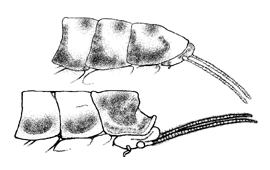
Figure 2: Side view, illustrating differences in the thorax and antennae in female (top) and male (bottom) Madagascan roaches.
It is this large size--as big as a small mouse--and the ease with which these roaches can be reared that recommends them to those who are looking for large invertebrate prey for insectivorous lizards and tarantulas. A peculiar advantage is that these hissing roaches do not have any odor associated with them or their feces. A breeding colony of several hundred large individuals can therefore be easily maintained in a 15- to 20-gallon aquarium without odor, something that cannot be said for either mice or for other large roaches. The practical utility for someone who wants to rear their own large insect food in the room of a house is obvious. Last, as I hope to show in the ensuing article, the roaches are incredibly interesting in their own right
Breeding and Life Cycle
Female hissing roaches lay their eggs in a purse-like capsule known as an ootheca. This egg case is retained within the body until the eggs hatch, and the young roaches first see the world as tiny nymphs. You may occasionally see a female with the ootheca extruded. Such a female is in the process of forming the ootheca. Once it is completely formed she will retract it into a special cavity in the tip of her abdomen
A female that has been successfully fertilized will retain the eggs within this cavity for at least 60 days. These females may be left with the colony. Once born the young nymphs will not be eaten by the adults. This fact makes it possible to keep all stages of hissing roaches together in the same container
Links to Other Sites
Buy Roches! (not from me) |