|
As many as 200 adult roaches may be kept in a ten gallon aquarium. Use cardboard egg cartons to provide hiding places and multiple living levels.
A heat stripe or pad should be kept under one end of the tank. Temperature range on the heated end of the tank should be between 80-90 degrees F. At the other end of the tank place an inverted water bottle.
Foods that may be fed are baby chicken starter mash, grains, high protein baby cereal, fish flakes, etc.
A screen top is not enough to keep the roaches from escaping the tank as they can climb glass. Take a paint brush and a jar of Vaseline and paint the top two inches of the inside of the tank on all four sides with Vaseline. The roaches will not go past the Vaseline.
The Madagascan roaches have a life span of two to three years. They also produce live young. Each female is capable of bearing twenty to thirty babies at one time.
The roaches do not bite. The hissing sound they make is actually air that is being pushed in and out of their sides. Males hiss loudly when fighting but hiss softly when mating.
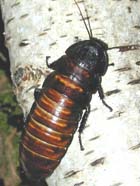
In sexing these insects the male has horns on the top of his head. The female is lacking these horns and the top of her head is smooth.
The Madagascan offspring are a perfect feeder insect for all reptiles and amphibians. The Madagascan roach can be bred with ease for a steady supply of food for any insect eating reptile or amphibian. The cost of maintaining a colony is minimal, which makes breeding them as a food source very cost effective
|
|
What you’ll need:
Around 12"x8"x8" aquarium or pet pal (minimum), 2 small bowls (one for water, one for food), a small heat mat, coir (peat substitute), something for them to hide under (e.g.. piece of cork, half a plant pot), plasticplants (optional),close fitting lid (plastic tanks often come with one or for a glass tank a vivarium or home-made lid can be used).
Housing:
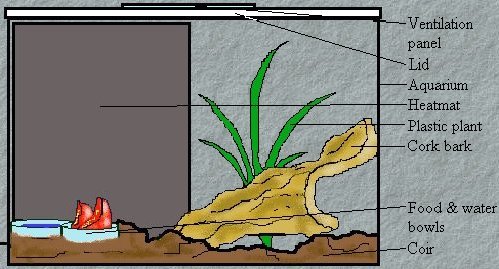
Hissing cockroaches require a warm, humid, escape-proof environment. Both glass aquaria and plastic ‘pet pals’ aquaria are suitable housing but will need some slight adjustments. In order to maintain humidity (70-80% is best) and prevent escapes the majority of the ventilation holes will need to be sealed.With ‘pet pals’ this is most easily achieved by taping them up (on the inside of the lid) and just leaving small spaces between each strip (about 1mm). Young cockroahes can get through very small gaps so if you intend to breed hissing cockroaches you must make doubly sure there are no gaps around the lid or any ventilation holes bigger than 1mm (if any do escape they will not survive around the average British home as it is not warm enough for them to breed and they will eventually die). The floor of the setup should be given a 1-2" deep layer of coir/peat substitute as substrate (make sure when buying it has no added chemicals or pesticides) which should be kept slightly moist but not wet. Plastic plants can be added to the setup for decoration (the cockroaches will eat real ones) and a couple of pieces of cork bark should be provided to give the cockroaches some where to hide
Heating:
Heating for the setup is best provided using a heat mat as sold in pet shops for reptile care. This should be positioned on the outside of the setup along the back wall and cover no more than half this area (as shown in the diagram). This way the the heat mat will produce a heat gradient within the setup allowing the cockroaches to regulate their own temperature by moving between the warm and cool areas as they would do in the wild. They seem to like temperatures in the range of 75-80°F best.
Feeding:
Hissing cockroaches are ‘detritivores’ or ‘decomposers’, which means that they are nature’s cleaner-uppers and will eat almost any dead and decaying organic matter they come across. In captivity they will do well if fed on a variety of fruit and vegetables (including kitchen scraps). Fruit and vegetables will need washing before-hand though as hissing cockroaches can be susceptible to pesticides that are used on these. The food will only need changing about once a week as they are not fussy about its condition. A shallow water bowl can be provided for them but this is not essential if they are getting regular moist food (ie. fruit and veg).
Cleaning:
Hissing cockroaches do not produce a great lot of mess (unless kept in large numbers) so will only need their substrate changing around once a month . Apart from this the glass will need wiping now and then for veiwing (no chemicals, only warm water should be used for cleaning). Breeding:
Adult male and female hissing cockroaches are fairly easy to tell apart. Males have prominent horns on their pronotum (just behind their head) and are generally slightly larger than females. These horns are used by the males to push each other around in contests over females. Once you have a pair of cockroaches (or better, a small group of 4-5) and they have settled into their setup it won’t be long before they breed. After mating, the female produces a bright yellow egg sac (or ootheca) containing 30-40 eggs which she protudes from her abdomen then reabsorbs, incubating the eggs inside her body. Eventually she will give birth to live young which resemble brown woodlice when first born. The young cockroaches can be kept under the same conditions as the adults and can be raised along with them. They will reach maturity after 8-10 skin moults which takes 10-12 months.
Handling:
Hissing cockroaches are perfectly safe to handle. Adults can be fairly skittish to start with and hiss a lot when picked up, but with regular handling will soon settle down. Babies up to their third or fourth moult should be handled as little as possible as they can be damaged quite easily (they can also be very fast and may get away from you).
Other species:
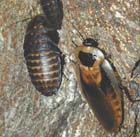
The Death's Head cockroach (Blaberus cranifer) is another species of cockroach that is commonly kept as a pet. It is light brown in colour with black legs and underside, and black blotchy markings on its head that are said to look like a skull (hence the name). They also possess large wings although they are unable to fly. Breeding is sexual with the male performing a strange flapping dance to the female before mating. The female gives birth to live young (about 25-30) which take about 6 months, and 9 or 10 moults to reach adulthood, after which they will usually live for about 1 year. The nymphs are wingless (the wings come with the final moult to adulthood), speckled brown and black, and look prehistoric, resembling miniature trilobytes. This species breeds well and can be kept under exactly the same conditions as described for the Madagascan hissing cockroach.
|
 Other roaches
 |